Showing posts with label non-fiction. Show all posts

Monday, January 25, 2010

Jumping through Fires


Jumping through Fires is an interesting title, isn’t it? The subtitle makes it even more interesting: The Gripping Story of One Man’s Escape from Revolution to Redemption. Then, lower on the cover, under the author’s name (David Nasser), is written: An Iranian Exile and Former Muslim.

Well, how on earth could I not grab this book off the library shelf? I had to.

Nasser
is a compelling author, telling the story of his family’s escape from the Iranian Revolution in the late 1970’s. It’s a scary story,especially since it's told from the perspective of a nine-year-old boy. He then tells of the difficulties of adjusting to American life - the story of Iranian immigrants coming to America at the worst possible moment.

This book is honest and forthright. Nasser tells us not only about the difficulties, the moves, the inability to fit in at school, but also about his mistakes, his choices, and the consequences of those choices.

It’s the story of his journey of faith, of alienating his parents, of doing really stupid things and learning from his mistakes. It’s the story of falling in love with an American girl, of carefully rebuilding a relationship with his parents.

It sounds rather unexciting when I write about it. But in Nasser’s words, it’s worth reading.

Saturday, January 23, 2010

The Boy from Baby House 10

The Boy from Baby House 10 by Alan Philips and John Lahutsky is a captivating read. Once I started reading it, I could hardly put it down. I think the only thing that kept me from crying throughout the entire book was its subtitle, From the Nightmare of a Russian Orphanage to a New Life in America. I knew it had a happy ending. But many times in the book, I wondered HOW?

It's the story of John Lahutsky (his American name), and the people in his life who fought for him to have a life. We first meet Vanya when he is four years old and in a Russian orphanage. The situation is horrifying – it’s amazing that Vanya can even speak because the women who care for him hardly interact with him. I cannot help but admire Vanya’s unquenchable spirit which fights against all odds to be noticed, to interact with adults and children around him.

It’s this spirit which attracts the attention of some adults from outside the baby house, women who work tirelessly to rescue him from his classification as an “imbecile” because of his slight physical disabilities. His journey is a long one, and includes a horrifying, though mercifully short, stay in an adult mental asylum when he was six.

As John says in the Preface, “I am told I may be the only child to have survived the worst type of institution n the Russian children’s gulag and gone on to live a normal life in America. These institutions created by Stalin continue to devour children to this day.” (emphasis mine)

It is heartbreaking, this devouring of children. As you read this story, you’ll agree that is the only way to describe it. The people who fought the Russian bureaucracy on Vanya's behalf are heroes in my mind.

I was struck by something Philips wrote about halfway through the book, and its implication. “This was the monstrous logic of the Soviet state childcare system. The Communists had downgraded the family, decreeing that the state should take over the care of children who were destined never to grow into able-bodies workers, which in reality meant hiding them away and depriving them of contact with their families, education, and medical treatment.” (emphasis mine)

This is the logical conclusion of current theory that states parents are not qualified to parent their children. The logical conclusion that child-rearing is better left to “professionals.”

The Boy from Baby House 10 is a powerful testament that such thinking is destructive – it destroys parents, siblings, and children... thereby destroying society.

Friday, January 15, 2010

The Noticer


The cover of Andy Andrews' book, The Noticer: Sometimes, all a person needs is a little perspective, has a quote from Nancy Lopez, LPGA Hall of Famer. She says, "This is the best book I have ever read in my life."

That's high praise for this little book. One with which I cannot agree.

Don't get me wrong, The Noticer is interesting. And the message about perspective is important. However, I would compare it to an aerial view of a landscape. An interesting view, but you miss a lot of details.

The Noticer is a parable told somewhat in first person about a man who shows up, talks to people about their lives to give them some perspective on their seemingly impossible problems. One conversation with Jones changes their lives forever.

One chapter I read was a quick overview, with a few changes, of Dr. Gary Chapman's book The Five Love Languages. Another focused on taking control of your thoughts, while another focused on being thankful.

Each chapter covered a different difficulty, with a very quick lesson on perspective and a few practical tips on how to apply that lesson. It's very easy to read, and very easy to forget.

Overall, The Noticer is worth reading. It will give you some ideas for seeing your life from a different perspective. However, you'll need to read some other books to deal with issues in depth if you want to make that change permanent.

Monday, January 11, 2010

have a little faith: a true story

My sister-in-law told me that her book club was reading have a little faith by Mitch Albom, of Tuesdays with Morrie fame. I have to admit that I haven't read Tuesdays (I know I should), but I spotted have a little faith on the library shelf and snatched it up to read it over the holiday.

I have to tell you that I thoroughly enjoyed this book. I appreciate Albom's transparency in his spiritual journey, and the similarities and differences between the two men of faith with whom he interacts are intriguing.

Interestingly, Albom organized the book into seasons of the year - which correspond to the seasons in his friendship with these two men. One is his rabbi, who springs a rather unusual request on him one day. The other is a pastor in a rundown urban church in Detroit. It seems these men would have nothing in common with each other except a relationship with Albom.

You'll have to read the book to find out what else they have in common.

I can't help but mention that Albom writes from the post-modern viewpoint of "I'm OK, you're OK" - basically that as long as you have faith and quit running from God, then you'll find enrichment and fulfillment. Personally, I believe there is an absolute truth to which we will all be held accountable.

Overall, have a little faith is a heart-warming story worth reading.

Monday, January 04, 2010

How to Be a Hepburn in a Hilton World


I was intrigued by the title of this little book How to Be a Hepburn in a Hilton World: The Art of Living with Style, Class, and Grace by Jordan Christy. I wasn't sure that anyone could write an entire book on the subject, but I was wrong.

I'm certainly not the target audience for this little book. It was written more for teens and twenty-somethings. However, I did enjoy it. Christy does a great job of giving good reasons for taking care of yourself without buying into the current culture obsession with thin and tiny. She also makes a great case for covering up - choosing clothes that leave something to the imagination instead of bearing all.

Christy covers all aspect of life - dress & style, words, working hard, being a nice person, how to interact with boys, even hair and makeup. She includes little quizzes in several chapters to help readers figure out their style, what colors look best on them, among other things. She offers many practical tips and sound reasoning behind her recommendations.

I enjoyed reading this book, and will seriously consider reading it with my daughters when they get older.

Friday, January 01, 2010

Loops


I picked up Loops: The Seven Keys to Small Business Success because I noticed it was co-written by Stephen Lundin, who also co-authored Fish! I absolutely loved Fish! It's a great business book that every small, medium or large business owner or manager should read.

Loops is a small book, and I knew it wouldn't take long to read. I suspected it would be written in the form of a parable, and I was right.

The story centers around a young man who's finishing his junior year in business school. He is given a summer assignment to study a successful businessman, and he decides to study his late father.

The story is a hook, a way to easily get the author's points across in a way that readers will enjoy. So don't expect great character development here, and parts of the story sound quite hokey. But don't let that stop you from reading this book.

In fact, if you're a small business owner, I'd encourage you to read this book with a group of like-minded people. It's a great book for discussion, with application points at the end of each chapter to help you make your business strong and successful. Plan to meet once a week or once a month, and plan on about ten meetings - one for Part One, one for each of the seven loops, and one for the conclusion.

Reading the chapters won't take much time, even if you're a slow reader, but what will make this book powerful is following up and applying the principles to your business.

Tuesday, December 22, 2009

Ad Nauseam


I thought the title of this book sounded intriguing: Ad Nauseam: A Survior's Guide to American Consumer Culture.

Apparently it's a compilation of content from a magazine called Stay Free!, which started as a music magazine, but has morphed into a satirical critique of, you guessed it, America's consumer culture.

I found most of the book interesting - especially the part about how children view commercials. However, after reading several hundred pages about advertising, our consumer culture and the latest techniques advertising agencies are using to get inside consumers' heads, I had to put it down. I felt like the book was continuing on and on and on, ad nauseum (ha!).

The last couple of sections of the book I just skimmed or skipped. Overall, I found the book interesting, but a bit overwhelming. I can see how digesting culture critique in a magazine form is much more palatable, than in book form.

Saturday, December 19, 2009

Green Goes with Everything


I gave a friend a copy of this book, Sloane Barnett's Green Goes With Everything. A few weeks later, she told me she could only read it in small doses because she found it so alarming.

After I read it I understood what she meant. I knew most of this information in this book from various other resources, but reading it all together in one location can be overwhelming.

However it's information everyone needs to know, and Green Goes With Everything is worth the read.

I really like the way Barnett writes in this book. She's a news correspondent, and I can tell. She has an easy-to-read writing style - very practical, with lots of pop-out boxes of information you can look over easily. This would be an easy book to read in snatches of time - waiting in line at the post office or in the car for the children after school or the like.

In the interest of full disclosure, Sloane Barnett is the wife of Roger Barnett, the owner of Shaklee Corporation. She doesn't try to hide that fact - and addresses it in the introduction. The interesting thing is that this book is not a sales book for Shaklee. She mentions their products periodically throughout the book, but nothing like I expected.

Instead, she gives lots of research as to what goes into the cleaners available at the stores... and several different alternatives, including Shaklee's.

If you're wondering what the big deal is about non-toxic cleaners, and are convinced that your laundry detergent is "just fine, thank you," or love to put those plug-in fragrances all around your home, I'd encourage you to read this book. It will certainly give you something to think about.

I have an extra copy of this book I would like to give away to someone. So here's the deal - become a fan of my business, Healthy Homes, on facebook to enter a drawing. I'll have one of my kids draw names during the second week of January and send the winner the book.

That way you'll have all the information you need to get started on your New Year's Resolution to keep your house cleaner in 2010! (picture me grinning)

Friday, December 18, 2009

Help! Around the House


I am almost shivering in anticipation. I checked out a huge stack of books to read over the holidays. All of them are purely for pleasure... none business related. I can't wait!

However, I must finish writing about the books I've read already this fall. One of them is Help! Around the House by Don Aslett.

Aslett bills himself as America's #1 cleaning expert. He is certainly a hard worker and a prolific writer. I've read several of his books and it's amazing how excited he is about cleaning and finding the best, quickest and easiest way to clean.

He almost makes me want to clean. Almost.

Several years ago, I read his books and got on his e-mail list. At some point he sent me a survey to fill out. The topic was how to manage clutter and get kids to help around the house. The incentive was that if he quoted me in the book he was writing, then I'd get a free copy.

Well, I always have opinions on managing clutter and getting kids to help, so I filled it out, sent it in, and promptly forgot about it.

Some time later, I got my own signed copy of Help! Around the House in the mail. How fun! My name is mentioned in the credits, but do NOT ask me to find my quote. I paged through it then and couldn't figure it out. And now, many years later, I've finally read the book and still can't figure it out.

No matter what my quote was, the book itself is good. Aslett is a very engaging, easy-to-read author with a ton of practical hints, tips and ideas. The thing I like about this book is the many, many quotes from real moms with ideas they use. I also like that he doesn't hold up one system as the system to follow, but instead encourages us to find what works for your family.

I can't help but encourage families with children to choose non-toxic cleaners for your home. There are oh-so-many reasons to do so, which I won't go into right now. It's very important for the health and safety of your children. If you're concerned about costly or ineffective non-toxic cleaners, let me recommend Shaklee's cleaners. They work, are cost-effective and are safe. I grew up using them, and so are my children.

If you're a mom, or a dad, who would like to have a cleaner house, would like to have your children's help in getting the house clean, I'd recommend reading this book. You'll enjoy it, get some good ideas and even laugh out loud. I did!

Thursday, December 17, 2009

Bringing Up Boys


I first read Dr. Dobson's Bringing Up Boys when my oldest son was small - not quite ten years ago. I didn't remember much about it, except learning to allow my boys to play guns, be loud, and run a lot. That information was helpful as my boys went through the toddler, preschool and elementary school stages.

Now that my oldest is in junior high, I felt I needed a re-read of this classic.

It was a good reminder of the previous lessons learned - keep my boys active, allow them to be loud, send them outside as much as possible.

But this time, the thing that resonated with me the most was the idea of feeling isolated as a parent. For those who know me, I am not isolated. I have good friends, near and far, and a supportive family, both in my hometown and out. Then why do I still feel isolated?

Dr. Dobson quotes an essay by Ellen Goodman which, I think, nails it perfectly. It's too long to quote here, but you can find it on page 202 of the edition pictured here. It's worth a read - even if you just read it in the aisle of the local bookstore.

In it, Goodman talks about (in Dr. Dobson's words) "this battle to protect children from the harmful influences of our day."

Goodman says, "it occurs to me now that the call for "parental responsibility" is increasing in direct proportion to the irresponsibility of the marketplace. Parents are expected to protect their children from an increasingly hostile environment."

I cannot count the times I've had this conversation with other parents, shocked over the stories we hear on the news. "Kids these days," one of us says. Another says, "No, it's the parents. Parents have the responsibility."

Yes, we do. I agree. However, protecting our children in today's world is exponentially harder than it was for my parents when I was a child. As Goodman says, "Americans were once expected to raise their children in accordance with the dominant cultural messages. Today they are expected to raise their children in opposition."

And then, in Christian circles, we have debates over 'sheltering' our children from the dominant culture. So-and-so shelters their children too much. Such-and-such family allows their children too much freedom and doesn't shelter them enough. So much judging of each other instead of supporting and encouraging each other in an increasingly hostile world.

This whole discussion is not the focus of Bringing Up Boys, but one for which I obviously needed some clarity. It's especially important in raising our boys because of the wide variety of unhealthy, violent or just plain - dare I say it? - stupid role models for our boys today (what sit-com today doesn't spend most of its time poking fun at men?).

I am very careful what kind of TV my boys watch, video games my boys play, and encourage them to spend time with their dad, grandfathers and other men who I see are real men. Men who know being a man involves responsibility, hard work, caring for others, treating women with respect and gentleness. Bringing Up Boys gave me the vision for starting down this path, and reading it again has helped me to refocus on it again.

Tuesday, December 08, 2009

Crazy Love

I have a stack of books for which I intend to write reviews. Literally - they're on top of my dresser, just waiting for me to find the time to sit down at the computer and write about them. Somehow, with Thanksgiving happening and Christmas coming oh, so soon! I've neglected my blogging. Now, I have almost too much to talk about, so I procrastinate. (Something I learned from my dear husband.)

But then I picked up Crazy Love; Overwhelmed by a Relentless God by Francis Chan from the library. It was exactly what I needed to read to get my focus back. As we read this morning in our devotions from Matthew 6:
The eye is the lamp of the body. If your eyes are good, your whole body will be full of light. But if your eyes are bad, your whole body will be full of darkness.

My 'eyes' had been bad - coloring my perspective on life with a dullness of 'making it through' rather than 'enjoying the moments.' Wondering 'how' and 'why' and, dare I admit it, 'what's in it for me?' instead of thankfulness, gratitude and wondering at the fact that God loves me - no matter what.

In Crazy Love, Chan focuses on God and on his 'crazy love' for you and for me. He reminds us of the majesty, wonder-ness and awesome-ness of God Almighty, Maker of heaven and earth. And of how much He, the Holy God, loves you and me.

Then Chan turns his attention to our response - or lack-thereof - in the church today. He advocates a passionate response to God, one that makes most church-goers (including myself) a bit uneasy. He profiles the lukewarm Christian today and encourages Christians today to be obsessed with Jesus and following Him.

It may sound like reading this book could make you feel guilty for what you are, or are not, doing in your life. And to some extent, that's true. But Chan ends his book with this:
My hope and prayer is that you finish this book with hope, believing that part of your responsibility in the body of Christ is to help set the pace for the church by listening and obeying and living Christ. ... [Y]ou simply need to live out in your daily life the love and obedience that God has asked of you.

A breath of fresh air - and a great reminder to readjust my focus so my eyes see this life properly.

Thursday, November 12, 2009

Get Motivated


I have to admit, I'm a skeptic when it comes to motivational books. I've read quite a few, and it seems like they all say the same thing, just in a different way. Plus, most of the techniques feel very 'new-age' to me, and in reality some are.

Last month, my friend went to a motivational seminar produced by Tamara Lowe, the author of Get Motivated. I think she knew I am skeptical of those types of events, because we didn't talk about it much. However, our mutual friend filled me in when we were talking about my experience at the Shaklee national convention.

She told me about Lowe's book, Get Motivated, and the motivational DNA test you could take on her website. I was intrigued - mainly because I thought something must be wrong with me.

Why would I think that? Because the most valuable part of the national convention for me was reconnecting with people with whom I mostly interact on the phone. Otherwise, the focus on making the 'big money' in Shaklee during the convention meetings made me uneasy and uncomfortable. I was left wondering why I had taken the time, and money, to attend. (After sitting back and thinking objectively about what I had heard at convention, I realized that if someone is motivated by money and performance, that person could make a lot of money with Shaklee. It's amazing, really, but not motivating to me.)

During our discussion, she mentioned it sounded like I am motivated by relationships, and said a few words about what she had learned from reading Lowe's book. I immediately got online and requested it through inter-library loan.

Lowe's personal story is quite amazing, and her drive is impressive. I almost hate admitting that I enjoyed reading this book. Her idea of Motivational DNA is a new one to me, and it makes sense. I discovered my Motivational DNA is CSI (not like the TV show, but Connection, Stability and Internal). DNA, by the way, stands for Drives, Needs and Awards. Yes, a bit cutesy, but it is memorable.

I was looking forward to reading the section about motivating children, but after I read it I felt a little let-down. It was a very, very quick overview - mostly anecdotal of her relationship with her oldest son - of childhood stages. She mostly recommended reading certain authors for a better understanding of parenting techniques. They are authors I enjoy reading, for the most part, but I was hoping for a little more direction from Lowe about applying her theories.

Overall, if you're wondering why you're having problems getting motivated, or trying to figure out how to motivate employees or children, I'd suggest reading this book. It might even be worth purchasing, so you can have her run-downs of each motivational type.

Wednesday, November 04, 2009

Survival


This book turned out to be nothing like I thought it would. The title, Survival: How a Culture of Preparedness Can Save You and Your Family From Disasters, implies a sort of self-help book, helping you prepare for such disasters as you may face in your part of the country.

The book is far more interesting than that. It does have information on what supplies to have on hand - but that information is in the appendix.

Apparently, I didn't pay enough attention to the Hurricane Katrina coverage, or I would have been familiar with the author, Lt. Gen. Russel L. Honoré. He became the 'face' of the Hurricane Katrina disaster. Apparently, he was all over the news. He explains his official role and job title in the book.

Survival is more like Honoré's autobiography - with "Lessons Learned" at the end of each chapter. He is certainly confident in who he is, if perhaps a bit egotistical. But, he makes some interesting, and good, points, even if I don't necessarily agree with all of his "Lessons Learned."

There are several things I appreciate about this book. First, for a military newbie, he has a semi-understandable explanation of the difference between the National Guard and the Army. He mentions the Posse Comitatus Act several times, which limits what the Army can do on US soil. I point that out, because when I was watching season seven of 24, one of the characters mentions it, and I knew what he was talking about - which I wouldn't have if I hadn't been reading this book. The complicated structure of command is still a bit confusing for non-military people, but I have a better understanding of the difference.

Second, Honoré continually stresses a culture of self-reliance and preparedness. Preparing my family for disaster is my job, not my government's job. Preparing the community for disaster is the job of local government officials, not the federal government. Honoré makes this point when he describes touring southwest Louisiana with President Bush after Hurricane Rita.
"It was obvious from [the local mayors] conversation with [Bush] that they were expecting miracles from the federal government. He wasn't responsible for not having enough gasoline or generators or high-water vehicles. He wasn't responsible for their lack of planning." (pg 188)
Third, Honoré advocates a culture of planning ahead for disasters, instead of scrambling to respond to them.
"The present disaster response system is based on the "pull" model of operations. An event happens, local authorities ask for help, and that help is pulled into the area. We have to base our response more on the "push" model. If we see an event about to occur we push resources into the area ahead of it. ... It's a basic concept of good planning and preparation." (pg 195)
Honoré admits this costs more money, but if this model had been followed, Hurricane Katrina wouldn't have been so devastating to New Orleans. It is especially ludicrous that experts knew what kind of devastation a hurricane could bring to New Orleans, but local officials didn't prepare for it. A great many people have suffered because of their own lack of planning, and that of their local government.

It reminds me of the difference between 'responding' and 'reacting.' What we saw with Hurricane Katrina was a 'reaction' to a disaster, instead of a 'response' - at all levels. A response is more planned, less emotional. A reaction is quick, chaotic and emotional. I prefer to respond to people and circumstances, rather than react to them. So I could relate quite well to Honoré's points in his book.

I also realized that Glen and I have some work to do to make sure that our family is prepared for disasters we might face here in the Midwest. Thanks to Honoré's clear outline in Appendix 5, we have a good starting point.

Wednesday, October 14, 2009

The Murder of King Tut

I would dearly love to get my father's opinion of this book - James Patterson's The Murder of King Tut. My dad is a former junior high history teacher and an amateur Egyptologist.

So, I'd love to know what he thinks of Patterson's theories and ideas about the death of King Tut. I'm not sure what to think.

This is a non-fiction work by Patterson, a best-selling mystery writer. I don't recall reading any of Patterson's fiction, but may have many moons ago when I was single, working nights and reading lots more. (Yes, there was a time when I read more.)

In The Murder of King Tut, Patterson writes a story based on lots of research done mostly by Martin Dugard, who gets credit as his co-author. He weaves three stories into one - his theories about what happened in ancient Egypt, Howard Carter's famous life's search for a missing grave (which ended up being Tut's), and his own experience in researching and writing the book.

Generally, it's easy to follow, except when it comes to the ancient Egypt part. I would have appreciated a short genealogy and/or character list in the front of the book, so I could keep track of the ancient pharaohs whose names look so similar. I am somewhat familiar with Egyptian history, with my dad's intense interest in it and having taught it to my kids twice over in our home school, but I still felt confused as to exactly which pharaoh was which.

Overall, this book is easy to read, fairly easy to follow, and with interesting theories to ponder.

Tuesday, October 13, 2009

Culture of Corruption

My husband enjoys politics. He could talk politics all the live-long day, if he had an interested and participating person. I, unfortunately, am not that person. Quite frankly, politics bore me. Which is really quite ironic, considering I interned in my state capitol for a semester when I was in high school. Being a page during the annual fall veto session of my state legislature probably killed what little interest I had in politics.

Which makes me quite surprised that I actually picked up this book, and even more surprised that I not only started, but finished it. I probably did because even a non-politico like me has to start getting involved in state and national politics. We in Illinois have the dubious distinction of sending one former governor to jail, and impeaching a sitting governor. Corruption is so ingrained in Illinois politics, it's hard to believe that anyone who has been involved in politics in the past 15 or so years in this grand ol' state is immune.

And considering that our current president is most recently from this grand ol' state of mine... well, you can connect the dots.

Michelle Maulkin connects the dots of corruption and 'pay-to-play' quite well in her book Culture of Corruption. This book is well-researched, well-documented, and should shock anyone lethargic about politics into action.

I will say that reading this book made me realize I am more of a big picture person than a detailed person. I completely got lost in the details of who got the job for this person, who in turn used their influence to acquire state contracts for that first person - or even more convoluted than that.

I did figure out that the big picture of Culture of Corruption is that Obama says one thing, and does quite another. As my parents always said, "Actions speak louder than words." And the actions of the current administration are quite sickening.

Let me point out that Maulkin is quite critical of the former administration too. "Pay-to-play" is not limited to the Obama administration - it's just much more prevalent and/or obvious this time around.

If you're politically lethargic like me (I want to point out that I do vote), this book will force you to pay more attention to those in power, no matter their political affiliation.

Friday, October 02, 2009

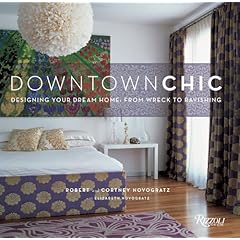
Downtown Chic

I have this stereotype of the decorating gurus. You know - single, or married with no kids, unrealistic expectations of how a home is used. The kind with houses that are always showcase, picture perfect because there are no children around to mess them up... or if they have a child or two, everyone's gone all day long, so there's no time to mess it up.

My stereotype was completely blown out of the water when I read Downtown Chic: Designing Your Dream Home: From Wreck to Ravishing by Robert & Cortney Novogratz with Elizabeth Novogratz.

This couple, Robert & Cortney, are really down-to-earth people with an awesome eye for what works. They live in New York, of course. But they have six children. And their children share rooms!

I think I love this book for that very reason. I mean, I didn't know New York had any families with six children (two sets of twins, by the way). I didn't think anyone with the kind of income the Novogratz's have generated through their business had children who shared rooms. The four boys are in one room. I just thought you'd like to know that.

Granted - it's a large house. With a roof-top basketball hoop. The rooms the children share are probably bigger than my living room.

But they share. It's so out-of-vogue in the decorating books and magazines I've seen I can't hardly get over it.

I really like this book because Robert & Cortney are so real - especially for a couple who has a vacation home in Brazil. (Honestly, it blows my mind how a family of eight can afford to travel to Brazil more than once in a lifetime - guess that shows how small my world is.) Cortney shares how they kind of 'fell into' the business of redoing houses, even entire blocks of homes, in New York. Right place, right time, right synergy. I love that they realized their passion - they love traveling, shopping, renovating, and don't mind the mess.

The end result is stunning, but I wouldn't do well with the process. The process is where they seem to thrive.

A couple of things I missed in this book - perhaps because I read Sarah Susanka's Not-So-Big Remodeling recently. I missed a big picture of each house - the blueprints, more pictures of the interior living spaces. I don't feel like I could really replicate or even begin to create my own style with their sparse tips shared in this book. I think the main message is to allow yourself the freedom to experiment, make mistakes and surround yourself with what you love.

Perhaps that is something I can start doing.

Wednesday, September 23, 2009

The Gardner Heist

Right before our trip to Ohio for Labor Day, I did a quick walk-through the New Book section at my local library. I needed something to read for my trip - preferably more than one something.

The first book I grabbed was True Mom Confessions, which I blogged about here.

The second book I grabbed was this one: The Gardner Heist: The True Story of the World's Largest Unsolved Art Theft by Ulrich Boser.

I felt vaguely familiar with the story - the detail that the empty frames still hang in the museum triggered the thought I had read about this art theft before. But not enough to remember the details of it.

Boser does a masterful job of telling the story of the history of the Isabella Stewart Gardner Museum in Boston, as well as that of the theft. He introduces us to many interesting characters - insurance investigator Harold Smith and Isabella Stewart Gardner being a couple of the first. It is really a fascinating case - one which would take over Boser's life for several years. The story of his obsession is good reading.

The story of Boser's investigation does get involved. He admits to creating a database to keep track of the different people which whom he's talked - no wonder I felt like I was a little confused at points. But for me, that confusion did not overshadow the well-written, fascinating story of the Gardner Heist.

And I can tell you, a visit to the Isabella Stewart Gardner Museum is on my list when I go to Boston.

Saturday, September 19, 2009

True Mom Confessions + Pictures

Over Labor Day weekend, we traveled to Ohio to visit family. I always have to have something to read when I travel, and that weekend, I picked up True Mom Confessions: Real Moms Get Real from the library.

Nathaniel thought the cover hilarious, pointing out the little blurb above the title, which reads: "I haven't taught my kids to tell time yet...that way I can say it's bedtime whenever I want."

I looked at him and said, "Oh yes. I did that too." He looked shocked. Good thing I didn't tell him that as a stay-at-home, homeschooling mother, I chose not to teach him to tell time until he was at least six so I could put him in bed at 6:00 or 6:30. I'm not sure he would have forgiven me. (smile!)

Even if you're not a big reader, you will enjoy this book. It's mostly quotes from real moms who write anonymously on the TrueMomsConfessions.com blog. The book is organized by chapters into topics, with an introduction from the author, Romi Lassally. Each chapter ends with a short essay from a real life mom blogger.

It is a thick book, but with few words on each page, so you can feel good about finishing 266-page book in little snippets throughout your day. A definite plus for moms.

And, as promised (better late than never!), pictures from our trip, courtesy of Ann or Isaac, with some slight editing by mom.


Friday, September 18, 2009

not so big remodeling


Many years ago, my good friend Sarah introduced me to the book the not so big house: a blueprint for the way we really live by Sarah Susanka. Since then, I've occasionally perused the various books by Susanka. The pictures are beautiful, and it gave me ideas of what to look for in a house.

I found her newest book on the shelf in the library last week, and I cannot tell you how excited I was to check it out! not so big remodeling: Tailoring Your Home for the Way You Really Live is a gem. This one I read, cover to cover. The pictures are beautiful, and Susanka does a great job of teaching basic composition and architectural principles to those of us who lack a good 'eye.'

One thing I love about not so big remodeling is that Susanka assumes that all her readers will be operating on a budget, and some a very small one. She starts the book by describing her own remodeling project in her own house - separating remodeling projects into different categories: immediate changes to make the house more livable, improvements to the character of the house, house changes made because of life changes and what would be nice someday, but may not ever get done.

I enjoyed seeing the before and after pictures of Susanka's own house. The rest of the book is full of wonderful pictures - including before and after pictures and floor plans - of other remodels. Susanka deals with different parts of our house - the exterior, kitchens, bathrooms, bedrooms, offices, etc. She ends with whole house transformations - which she acknowledges is out of the question for most of us, but is necessary for some poorly planned homes.

It inspired me to pull out the tape measure and measure out our kitchen and dining/family room. It's layout is not working for our family, so I drew it to scale on graph paper, made copies, and tried out some ideas. I'm not a detail person, so I'm not sure I got the measurements exactly right, nor am I sure I know the clearance needed for pulling out chairs, etc. To do it right, I'd need to enlist the help of an expert. But it was fun to dream.

After dreaming for a little, I pulled out the Sunday paper to read it. On the front of the Homes section, was a huge article about a $6.5 million mansion in northwest Illinois for sale - over 18,000 (yes, that's thousand) square feet. The couple decided they wanted to sell after their son moved out. I gawked at the pictures of the entry way, the living room, the indoor pool, and saw the contrast between a showpiece and a not so big house advocated by Sarah Susanka.

Even if I had the money, hands down I'd prefer a not so big house.

Wednesday, September 02, 2009

The Hidden Power of Electronic Culture

I heard the end of an interview with Shane Hipps on the radio last month. He's the author of the new book Flickering Pixels: How Technology Shapes Your Faith. The book sounded interesting to me, so I checked it out online. Those who'd already read it recommended reading his first book first, so I did. (Have I mentioned how much I love interlibrary loan?)

I found The Hidden Power of Electronic Culture: How Media Shapes Faith, the Gospel and the Church quite fascinating. Hipps' background is advertising as a strategic planner, so he's quite familiar with media and culture.

Hipps bases much of his thinking on that of Marshall McLuhan, a very smart man who lived in the 1960's. He was a forward-thinker, and saw how the media we consume as a culture would change our thinking and our culture. Hipps introduces McLuhan in the second chapter, giving us some background into his education, thinking and status as pop culture guru in the '60's.

But first, Hipps challenges his readers to "realize that our forms of media and technology are primary forces that cause changes in our philosophy, theology, culture, and ultimately the way we do church."

Yes, his book is addressed to the church. But I think anyone who is interested in media's influence on our culture would find at least the first part of the book food for thought. I especially enjoyed his discussion of a couple of ancient Greek myths as illustrations of how we tend to look at media and how we should consider media - personally and corporately.

The first myth he discusses is that of Narcissus. The classic interpretation of it has been a warning against self-love, but Hipps favorite philosopher, McLuhan, saw it differently. He said Narcissus's chief problem was that
"he failed to recognize himself in the fountain's reflection. ... If he had understood that this fountain was simply a mirror reflecting his own face, Narcissus would have been able to dispel the power of the pool and gain control over it. ... Narcissus suffered because he became numb to the technology that came to enslave him."
Contrast that to the myth of Perseus - the son of the god Zeus. He volunteers to go destroy Medusa - the monster terrifying the land. Anyone who looks at her directly was turned to stone. Perseus uses a shield as a mirror to guide him and Medusa's stare has no affect on him because it's a reflection, so he cuts off her head.

Unlike Narcissus, who was unaware of the 'technology' that ended up enslaving him (his reflection in the pool), Perseus realizes he can control that same technology (a reflection off a shield), which allowed him to survive his ordeal.
"When we become aware of the specific ways in which technology and media serve as extensions of ourselves, much of their power is dispelled. We are returned to being owners of technology rather than those who are owned by it."
I don't know about you - but sometimes I feel as if I'm owned by my technology instead of the other way around. This book is a good foundation for being able to be a Perseus instead of a Narcissus (controlling technology instead of being consumed by it).

The rest of part one is a discussion of three basic forms of media - writing, pictures and radio - and how they changed our thinking, perception and culture. Part two is the start of a discussion of where the church goes from here - how our thinking has changed as a result of the media we consume, and Hipps thoughts on ways the church can engage the culture in terms it can understand.

I highly recommend The Hidden Power of Electronic Culture - and I am looking forward to reading Flickering Pixels.