Tuesday, July 21, 2009

Columbine

I am not one to be fascinated by huge news events, which is ironic considering my degree in Broadcast Journalism and my brief years in the field. However, I found myself picking up the book Columbine by Dave Cullen at my library.

It took me awhile to get around to reading it. I had planned on returning it to the library without reading it as I wasn't sure I wanted to read about such a disturbing event. But I did pick it up the night before we left for vacation, since I had packed all my other books for vacation reading.

I read a few chapters before bed. Then, the next morning, I stuck it in my bag to take with me. I'm glad I did.

In April of 1999, I had a one-year-old and I would soon discover I was pregnant with our second child. I did not watch the news, but no one could have missed the news of two boys going into their high school and killing 13 people and injuring many more. I had not paid attention to details of the case, but figured it was like the other school shootings - outsiders taking their revenge.

According to Dave Cullen, nothing was further from the truth. In his book, Cullen details the day of the attack, profiles the killers, several of the victims and the principal of Columbine High School. He gathers information from many sources - including several interviews with victims, victims' families, agents and investigators at the scene and other community leaders.

What comes out is how different Columbine was from other school shootings, how Eric and Dylan had planned this event for over a year and skillfully let others in on their secret without giving themselves away. I was shaken by the anger these boys felt - Dylan against himself, Eric against everyone else. And by how well they hid their anger. To most everyone they came in contact with, they were typical teenage boys, dealing with typical teenage stuff.

In my book club this summer, we're reading Shepherding A Child's Heart by Ted Tripp, and I found myself evaluating these boys in light of that book. This paragraph especially struck me, as we had just discussed behavior modification as a form of parenting that doesn't work.
"[Eric's parents] worried about Eric suppressing his anger. They admitted that he would blow up now and then ... It didn't happen often, but they were concerned. Eric responded well to discipline. They had controlled his behavior, but how could they contain his moods?" (pg 218)
Behavior modification controls behavior, but doesn't address the heart motivations of children. The fact is, they couldn't control Eric's moods - those were evidence of what was in his heart.

Which got me to thinking: I need to get to know my children as people, not just children. I need to talk with them, not just to them. And, I realize again that my children are their own people. They will make choices. Reading this book has driven me to my knees again, praying for wisdom and discernment when I interact with my kids and for them as they make choices for themselves - particularly their friends.

Columbine delves deep into the why of the attacks - showing again and again how Eric manipulated people around him, including his parents and other authority figures, and how once he decided to act, nothing was going to stop him. Dylan was always less committed to the plan - wanting to commit suicide more than kill others. But Eric needed a follower and Dylan needed a leader - a lethal combination which destroyed so many families, including their own.

Saturday, July 18, 2009

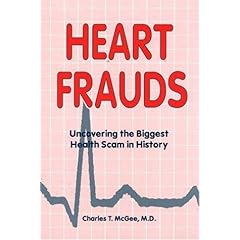
Heart Frauds

I decided I needed to read Heart Frauds, Uncovering the Biggest Health Scam in History by Charles T. McGee, M.D. after reading an excerpt of it online at books.google.com.

I had seen a dramatic picture of two rats, one fed with eggs and one fed with egg substitutes, and wanted to find the original source of that picture. It turned up in Heart Frauds, but I didn't feel like reading it on my computer. So I got the book through interlibrary loan.

Heart Frauds is a very interesting book. Dr. McGee attacks accepted medical practices aggressively - taking on the by-pass surgery (known as 'cabbages'), angiograms, angioplasties, even the theory that high cholesterol leads to heart disease. He examines medical studies, the history of these procedures and how they became accepted practices. He also presents alternative therapies and the studies which support, or are used to discredit, these therapies.

As I was reading the first part of this book, I kept thinking about the previously acceptable medical practice of letting blood and how now we know that practice was actually detrimental instead of helpful. I was more than a little surprised when McGee addressed blood letting, describing President George Washington's 'last battle' (pg 139-140). The point being that Washington was treated with the best medical care of his day, which we now know caused his death. McGee would say that the same is happening today - common medical practices for coronary heart disease are causing patients' deaths instead of helping them.

Dr. McGee argues that we've brought "arterial diseases upon ourselves through a combination of poor diets and lifestyles. However, it now has been proven to the satisfaction of the biggest skeptics in medicine that our arteries have the ability to heal and dissolve away fatty obstructions." (pg 96)

I found Chapter 13, "Reasonable Actions," the most practical chapter in the book - which makes sense because in it McGee discusses actions we can take now to prevent, manage, even heal heart disease.

He discusses foods we should eat (fresh, natural, minimally-processed foods, including eggs), and what foods we should avoid (refined and processed foods, especially vegetable oils, salad dressings, all margarines and anything that has been hydrogenated). It's in this section of the book that you'll find that dramatic picture of the rats. After seeing it, you'll never want to eat Egg Beaters. McGee also warns against the word natural.
"The word has no standardized meaning and is not regulated. Many processed foods are being advertised as being natural. According to common attitudes of the processed food industry, if an ingredient in one of their products was once a natural food, the end product can be called natural as well. Therefore we are told in advertisements that sugar and corn syrup are natural sweeteners because they come from cane and corn. In addtion, heat treated corn oil containing harmful trans fatty acids is advertised as being pure." (pg 164-165)


I find most of what McGee says in this book thought-provoking. However, McGee is a follower of Chinese medicine, which base their therapies on bring the body's energies back into balance. Fortunately, he only has a couple of sections in the book discussing these philosophies, which I think are more religious in nature than medical.

Bottom line: If you have heart disease, or a history of heart disease in your family, this book is worth reading. It's an eye-opening look at conventional medical practices, and will help you better evaluate your current lifestyle and any medical procedures you may eventually have to face.

Thursday, July 16, 2009

The Pleasure of Books

The boxes are waiting...
 

Opening the first box
 

Look at that beautiful binder!
 

Pulling out the books
 

I am unusual, I suppose. Most stories I hear about 'Sonlight Box Days' involve the children and the mom opening the boxes, oohing and ahhing over the books all together.

Me - I invite my friend Barb over for the momentous occasion. While my kids are gone, and someone's home to watch her son. It's just the two of us.

We oooh and ahh over the books as we go through the packing list. Wonder that yes, I will read all these books by next summer. She exclaims over books she's read about online, but hasn't seen in person. I get excited when I see titles I've always wanted to read, but haven't - like What Ever Happened to Penny Candy? - or when I see beloved books from my childhood - like Star of Light or King of the Wind.

We hole punch the stickers to help me, and the children, identify school books and take the time to painstakingly peel those backings off and stick them on the books.

I empty the shelves of last year's books - putting away Core 4 in a plastic container until the younger children are ready for it and packing Core 1 into the empty Sonlight box to take to a friend for her to use this year.

Opening the container with Core 2 is almost as exciting as pulling the brand-new Core 5 out of the Sonlight boxes. I comment on which books I loved most, pointing out to Barb which books she should read to her son this year, and telling her which books we will for sure be listening to instead of me reading aloud. (I love The Little Princess, but I cannot read it aloud. I have to listen to someone else read it.)

Two hours later, the books are on the shelves, complete with stickers. I've not put together the Instructor's Guide yet - still trying to figure out exactly how I want to organize it this year. But oh, did I savor the moments with the books. These books I will read aloud to my children, creating memories, learning things I never knew before. These books I'll read for the second time to my younger two - the books that are so delightful that my older two will happily sit and listen to them again.

Then, the children rush in. My niece is here this week and asks me, "Aunt Michelle, why are they acting like they've never seen these books before?"

"Well, Priscilla, because they haven't! At least for a long time."

My nine-year-old asks, "Hey Mom! Can I read A School Story? Please?"

"Yes, but please be sure to return it to the school shelf when you're done."

She finished it before bedtime. Her 11-year-old brother has already reread Amazing Bible Facts, and perused the shelf with his school books.

They're already asking, "When does school start?"

I'm itching to start too.

I love Sonlight because my kids love school. And so do I.
Posted by Picasa

Wednesday, July 15, 2009

The Unbreakable Child


Last week, I stayed up entirely too late reading this book. I went to bed late, and picked it up, thinking I would read for about ten minutes, then go to sleep.

Famous last words. Or thoughts.

Two hours later, I finished the book, with a tight throat and tears on my pillow. I've cried when I read books. I have never sobbed like I did when I read this one. Perhaps it was because I was over tired. Most likely, it was because my heart broke for the innocent little girl subjected to horrific abuse in the hands of nuns and priests, and the adult woman was now coming to grips with her past.

Kim Michele Richardson wrote this book after she had gone through a lawsuit against the Archdiocese and orphanage it managed. In the book, she goes back and forth between her child self and her adult self as she is forced to deal with childhood issues she had long since buried and tried to forget.

Throughout the whole book, one question haunts her, and for good reason. Who wears the face of God? Certainly not the nuns under whom she suffered so. Not the priest who molested her. Not the lawyer for the Archdiocese. Not the nun who accompanied him. I'm not sure she ever found the answer to her question. But that didn't stop her from asking it.

Kim is certainly an unbreakable child. The abuse didn't break her. But it broke her sisters, and countless other girls in the orphanage.

I commend Richardson for writing this book, exposing secrets she's wanted to forget, dealing with pain she'd rather ignore. I appreciate her vulnerability, and have learned from it.

Grandma's Story

Grandma’s always working, especially now that Grandpa’s recovering from knee replacement surgery. Our family went to Indiana this past weekend to help Grandma with things around the house, and to visit Grandpa in the hospital.


We had a good time, got work done and visiting in. One morning, Grandma and I found ourselves at the kitchen table with no children (amazing!) and had a little chat.


“Grandpa was very impressed with that green cream you put on his sore. It healed up nicely – do you know when it’ll be back in stock?” (Herbal Blend Multi-Purpose Cream: the first thing I pull out for nearly any skin-related issue. It should be back in stock July 24th.)


That question got us to talking Shaklee. Grandma started taking Shaklee about 2005, when I asked her to try it. Because she wanted to support me and my business, she did (bless you Grandma!).


Like many people, she thought it was pricey, and probably not worth it. This weekend, she told me that she’s noticed a difference. Others have too. Aunt Grace, a notoriously hard-worker, said, “You are looking good. It seems you have a lot more energy and stamina now.” I said, “Aunt Grace said that?” We were amazed! (Trust me, if you knew Aunt Grace, you would be too.)


As you can imagine, finances are tight for Grandpa & Grandma. Grandpa’s not able to work right now because of his knee replacement. He’s getting worker’s comp, but the budget’s been stripped down to bare essentials.


Grandma told me she saves her credit card’s cash-back bonuses to buy Shaklee, and any extra she can ‘throw that way,’ she does. She also takes half-doses: one Vita-Lea and B-Complex each day, a Sustained-Release C and Vita-E every other day.


It’s not ideal (ideal would be Vitalizer), but she’s making it work for her. And she’s noticing a difference, so she’s making choices so she can stay on her Shaklee vitamins.


Remember, the most expensive vitamins you buy are the ones that don’t work. Shaklee’s work – why waste money on something else? And Shaklee’s products are guaranteed too: satisfaction guaranteed or your money back.

Wednesday, July 08, 2009

Inside the Revolution

I first spotted this book on my Dad's coffee table. He was reading it. I asked him if it was good, and in his cryptic style he said, "It's taken me a long time to get through." Which I took to mean, 'yes.'

So, I picked it up from the library after he returned it. This is a hefty book, so it does take some time to get through it. It's worth reading all of it, because just reading part of it doesn't give you the whole picture.

Inside the Revolution is divided into three sections; Revolutionaries, Reformers, and Revivalists. The subtitle is "How the followers of Jihad, Jefferson & Jesus are Battling to Dominate the Middle East and Transform the World."

I found all the alliteration a bit over the top - but that is really a minor thing.

Joel C. Rosenberg, the author, based this book on hundreds of interviews (both on and off the record) and lots of research. He quotes Islamic leaders and Christian leaders, from the Qur'on and from the Bible. He profiles some of the major players in the Islamic world today - radicals, moderates and Christian leaders (although, for their protection, most of the later are given pseudonyms). All of this is supported by 23 pages of footnotes and five pages of recommended reading.

The first section, titled The Radicals, covers terrorists and would-be terrorists. The motto here is "Islam Is the Answer; Jihad Is the Way." Reading this section is eye-opening, and a bit scary. It helped me realize that there are sincerely evil people in this world, who justify their destructive means by their desired end result. Rosenberg clearly spells out why Iran should never get a nuclear weapon, and outlines the theology of the radical leaders - quoting from the Qur'on on and different religious leaders' speeches. He also delves into the world of al Qaeda and Hezbollah, and discusses the ongoing economic jihad which al Qaeda and Iran have been pursuing against the United States, complete with quotes and statistics. Like I said, it's scary.

Fortunately, in the rest of the book, Rosenberg introduces us to the other forces in the middle east, battling these radical Islamic leaders. In section two, Rosenberg introduces the reader to The Reformers who say, "Islam Is the Answer, Jihad is Not the Way." These Reformers are appalled by the Muslim-on-Muslim violence that the Radicals employ. They say Islam is a peaceful religion, and the Radicals are hijacking it for their own use. He outlines their theology, again including quotes from the Qur'on which support their interpretation.

He also introduces us to several of the leaders of this movement, including Hossein Khomeini (grandson of the Ayatollah Khomeini of Iran), Hamid Karzai (first democratically elected president of Afghanistan), Nouri Al-Maliki (prime minister of Iraq) and others. These leaders face death threats from the Radicals while trying to manage precarious positions - economically helping their people and at the same time working to stop terrorist activity in their own countries. Rosenberg is cautiously optimistic that these leaders can make a difference in the Middle East, and successfully fight the Radicals threatening to take over Islamic ideology.

In the third section, Rosenberg tells us about The Revivalists - those who say, "Islam Is Not the Answer, and Jihad is Not the Way; Jesus Is the Way." He profiles several high-profile, and not-so-high-profile, Muslims who have chosen Christianity over Islam. The transformations are amazing - and so are the numbers. Rosenberg details the Christian revival going on right now in radical and moderate Islamic nations. He also goes through the theology of the Revivalists, as he did with the Radicals and the Reformers, and discusses a bit of the Revivalists' strategy as well.

Rosenberg ends with a call for action. "Judeo-Christian civilization today faces the most dangerous moment in the history of the Islamic Revolution." (pg 489) He continues with:
"[F]ar too many in both the West and the East - political, military, and intelligence leaders as well as everyday citizens - are asleep to the gathering storm. In my (Rosenberg's) judgment, this lack of awareness poses the greatest danger of all. An intellectually honest, spiritually strong, morally courageous, politically united global alliance against the Radicals could be enormously successful. ... But should we succumb to the ignorance, apathy, callousness, hubris, and fear already so pervasive among many of our leaders, we will find ourselves facing cataclysms of biblical proportions that will make the attacks of September 11, 2001, pale by comparison." (pg 489)


Critics will say that Rosenberg is still living in the past, in the world immediately following September 11th. However, the Radicals are patient, and persistent. Their objective is clear, and our response is critical.

Monday, July 06, 2009

Protecting the Gift

Last summer, my sister was reading Gavin de Becker's book The Gift of Fear when we were on vacation. When she finished, I picked it up and read it. I found it helpful, and mentally put his next book Protecting the Gift on my 'to-read' list.

I finally remembered to pick it up from the library and read it. I found it very insightful, and helpful in thinking clearly about my children's safety. De Becker makes this point about making sure your children are safe in the first chapter: "[Y]ou can't be sure. There are, however, things you can be certain about. You can be certain every important decision is made with the best information. You can be certain you've educated yourself, certain you've made the best choice possible with the time and resources available. Above all, you can be certain you will listen to yourself, certain you'll give your hesitations a moment's consideration rather than later regret that you didn't." (pg 9)

De Becker walks his readers through strategies parents tend to use, like worry or overthinking, and encourages them to develop their intuition and act on it. Then he discusses circumstances in which children can be vulnerable.

I particularly appreciate his discussion of talking to strangers - instead of emphasizing "stranger danger," he recommends teaching your child to evaluate people with whom they come in contact. "Children raised to assume all strangers might be dangerous do not develop their own inherent skills of evaluating behavior. ... Fear of people is really the fear that we can't predict their behavior." (pg 83).

De Becker argues that we CAN predict violent behavior, and teaches us how in this book, and in The Gift of Fear.

Valuable points in Protecting the Gift include how to evaluate and interview potential babysitters, nannies, daycare centers, and schools. He also gives parents a letter template to send to the daycare center and/or school outlining expectations on how the parent and the administrators will work together to keep children safe.

De Becker also covers teaching teenage girls - and boys - how to protect themselves. He also encourages parents to step in, be unpopular, and make the right choices for their teenagers... and tells several stories to illustrate his point.

I appreciate the point he makes toward the end of the book about the importance of father's roles in children's lives - especially teenage boys. "[Nonviolence can be taught] and most effectively by fathers. Unfortunately, fathers are undervalued in America-virtually to the point of being an oppressed minority. That poses a problem for everyone, since the absence of a father in a boy's life is one of the predictors of future violence. ... While I've directed much of this book toward mothers, it is fathers who can most favorably influence a boy's behavior." (pg 239)

It was interesting read this book after reading Dr. Walt Larimore's book Bryson City Secrets. The combination taught me a lot about following my intuition and making hard decisions if I'm hesitant about leaving my children somewhere or with someone.

I said at the end of my post on The Bi-Polar Child that everyone who has contact with a child should read that book. I feel the same way about this book. Especially if you are a worrier, or tend to worry, you need to read this book. Worry is unproductive and can be detrimental to a child's safety. However, developing your evaluation skills and acknowledging your intuition not only can prevent you from being a victim, but your child as well.

Tuesday, June 30, 2009

Is Free Really Worth It?

I grew up in a bargain-hunting family. We bought what we needed at the best price possible. I’m still like that – which is why I choose Shaklee.

My friend, Harriet (she’s in on the right, I’m on the left), loves bargains, and Shaklee, too. I appreciate her perspective on choosing Shaklee – I’m sure my mother felt much the same way when she decided to switch our family to Shaklee products in 1975.
“It was a big step for me to buy my first bottle of Vita-Lea (Shaklee’s multi); I bought it only because IT CAME WITH A GUARANTEE -- feel better in 30 days or get all your money back. I was positive I would get my money back because I’d been taking C-----m (a store brand) for years and never felt any different. I had been taught in nurse’s training that all vitamins are the same so buy the least expensive.

You see, back in 1965 the U.S. Government said there was no difference between a synthetic substance and a natural substance. That is when vitamin companies could start making synthetic vitamins and still call them “natural”. Of course, it was cheaper to make synthetic vitamins. Even today a vitamin can be labeled 100% natural and contain only 10% natural ingredients. Today you can’t even recognize a good nutritional product because the industry isn’t regulated; it’s a buyer beware market.

Shaklee Corporation never made the shift to synthetic because of Dr. Shaklee’s philosophy—of producing vitamins in HARMONY with NATURE. Everything that goes into every Shaklee bottle is designed to make you healthier. Shaklee is different—it’s a company with integrity that you can trust.

After only a few days of taking Vita-Lea, I started feeling better with more energy. I got more done every day. It was worth it to me to buy Shaklee vitamins instead of the almost “fr.ee” ones because of how I felt. It’s been said that the most expensive supplements you can buy are the ones that don’t work and I believe it.”

So do I! Thanks Harriet, for sharing your experience. Today, Harriet and I both rely on Vitalizer for our daily energy boost and nutritional insurance. And it still comes with a guarantee – take it for 30 days, if you don’t feel better you’ll get your money back. Really, there’s nothing to lose.

What Would Google Do?

I picked up What Would Google Do? on the recommendation of the author of a couple of other books I've read and enjoyed. I thought the title was hokey (playing off the What Would Jesus Do? phenomena from several years ago), yet somewhat intriguing. What would Google do? And where exactly would they do it?

Jeff Jarvis, the author, walks the reader through how Google has not just changed the internet, but how people think and their expectations. He forces his readers to consider how this affects them, and especially their businesses. It's such a complete paradigm shift (over-used phrase, but oh-so-appropriate here), I'm still trying to digest it.

Some of Jarvis' challenges to the readers:
"What business are you really in?" (pg 80-81)

"I do believe that if companies were to ask themselves - and employees were empowered to ask - whether they were being good or evil to their customers and communities, they would often make different decisions." (pg 101)

"Google is seeing problems, solving them, and finding opportunities in them by thinking in new ways. This is all about finding your own new worldview." (pg 122)


Fortunately for us, Jarvis takes the second half of his book to apply the principles from the first half to business as we know it. He tackles media, advertising, utilities, manufacturing - a whole host of traditional industries which seem un-Google-able, if that is a word, and Googlifies them. It really is fascinating reading - probably made all the more fascinating if you were involved in such an industry.

One of my favorite parts of the book is the chapter titled "Google Power & Light: What Google Would Do." Google.org (the philanthropic arm) is actually involved in trying to reinvent our energy economy. It makes sense really. "If Google can help create cleaner, cheaper electricity anywhere it operates, it will improve its own bottom line." (pg 162)

Jarvis tells about his experience attending the World Economic Forum in 2008 and listening to Bono and Al Gore passionately plead for their core causes. Then he went to hear the Google.org forum.

"The contrast was stark. To summarize if not oversimplify their vantage points: Where Gore demands taxes and regulation, the Google team proposes invention and investment. Gore and company want to raise the cost of carbon - the cost of polluting - whereas the Google team wants to lower the cost of energy. ...

[W]e see different worldviews at work. "You can't succeed just out of conservation because then you won't have economic development," [Google.org executive director Larry] Brilliant said. "Find a way to make electricity - not to cut back on it but to have more of it than you ever dreamed of." ... Create and manage abundance rather than control scarcity - as ever, that is the Google worldview." (pg 163)


Jarvis goes on to contrast those two worldviews - create abundance vs. control scarcity. It reminds me of Paul Zane Pilzer's books - he writes based upon the same idea of creating abundance, though it's been so long since I've read his books I can't pinpoint exact quotes. Honestly, it brings to mind John 10:10 where Jesus says, "I came that they may have life and have it abundantly." That brings in a whole different discussion that I won't touch right now.

After I was finished with this book, my husband spotted it and asked me about it. I told him I'm still thinking about it, trying to digest it. He said, "Should we own this book? Should I read it?"

"Absolutely," I said.

I can't wait to get my own copy and start marking it up.

Wednesday, June 17, 2009

Tenth Stone

I will admit it straight out: I have been a huge Bodie & Brock Thoene fan for years. I started reading their books in high school, and haven't stopped since.

Their newest book is Tenth Stone in their series The A.D. Chronicles. I read it over the weekend. Yep, the whole book. Stayed up entirely too late Sunday night to finish it (and I'm still recovering!).

I am amazed at the attention to detail, the characters these authors bring to life on these pages, the captivating plots they create. Each book in the series could stand alone, but yet is also interwoven with not only the books from this series, but previous series they've written.

I've read so many of their books, but haven't written about them mainly because I think I should review the first book in a series, but not necessarily the rest of the books. And it's been awhile since I read First Light, the first book in this particular series.

However, in Tenth Stone, the Thoenes return to several characters they introduced in the second book Second Touch. I am so happy to read more about them, that I had to write about Tenth Stone.

Lily is the character I am just thrilled to know. She was a leper, cast from her own home as a child, who found her way to the valley of Mak'ob, home to a community of lepers. In Second Touch, you learn her story, her tender heart towards her fellow lepers and towards her God.

The thing I love most about Lily is her prayers. I remember a sermon once preached on Psalm 96:1 "Sing to the Lord a new song." I could not imagine singing a new song to God every day or even several times a day - until I met Lily.

Every time Lily prays, she gives God a new name. She did it in Second Touch, and does it again in Tenth Stone. Each new name for God comes from the situation she is currently dealing with - external pressures, internal fears, or both. Here's just a small sampling:

"I am praying again, Lord Who Knows the Hearts of All Men - rich and poor, proud and humble." (pg 90)

"I am praying again, You Who Command the Angels I Can't See. Did you tell them to remind Yod we shouldn't be afraid?" (pg 199)

"I am praying again, You Who Number the Stars and Number the Grains of Sand and Count the Stones of Zion among Your Treasures." (pg 211)

"I am praying again, You Who Sent the Redeemed to the Safety of Exile. ... Oh Lord, God of Exiles, Guardian of Ha-Golah, the exiled Stones of Zion, so it has come to this. You, our Redeemer, are in Exile with us all." (pg 220)


Tenth Stone is a great book - entertaining and interesting. It's also a great book to on understanding prayer, faith and what it looks like in everyday (well, perhaps not everyday), earthly circumstances.

Who of us has not been afraid? Take Lily's prayer from pg 199 and make it your own, praying through what is making you afraid. Who of us has not felt unnoticed, uncared for, or perhaps even lost in the midst of a much larger struggle? Take Lily's prayer from pg 211 and make it your own.

For me, the mark of a great book is one which captures my attention while also subtly teaching me a lesson. The Thoene's books do just that.

Tuesday, June 16, 2009

Modern Day Lament

Now that our children are getting older, my husband and I face a bit of a dilemma. I know it's not one that lots of families face, but we do.

Because I teach the children at home, and because I tend to be an early bird instead of a night owl, I am usually done about 7pm. So, my kids go to bed. Sometimes I'm done at 6:30 and they go to bed - especially if I know Daddy's working late that night.

So, now that I have a 6th-grader on my hands, it's time to rethink bedtime. Really?! I guess I wouldn't mind hanging out with him in the living room, each of us reading. But I don't want to talk. I really want to just watch TV.

Which brings me to my lament. My husband and I were just discussing how there are no shows we would want to watch as a family. Gone are the days of The Cosby Show, Full House, or Little House on the Prairie. Even The A-Team (although violent, no one ever got killed, and although Face always got the girl, you didn't see much).

What happened to these family shows? We were going through a few of the shows on in the 7:00 hour... and we wouldn't allow our kids to watch any of them. Chuck (our favorite)? Too violent & sexual. NCIS? Again not appropriate. America's Next Top Model? Definitely not something I want my kids watching.

We have the most basic of cable - don't even get TVLand or Nick at Night, which may run reruns of family shows. I guess we'll start haunting our library. Glen's excited about watching Home Improvement with the boys, which I don't think our library owns. He suggested a NetFlix membership.

I suggested reading aloud together.

We'll see what transpires... We've yet to break the news to my oldest that he can stay up later than his siblings. I'm waiting until we're done with our school year. Not sure why - except it makes me feel like I have a little more time to adjust. Plus, I have to finish Season 2 of 24.

Thursday, June 04, 2009

Bibles for Kenya

Last night, my mom and I ran up to Kenosha to see her second cousin, Linda, talk about her missionary work in Tenwek, Kenya.

Linda is like a member of our family. When I was a child, she and my mom's sister, Bev, were missionaries in Zaire (now Democratic Republic of Congo). When they came home on furlough, they lived with us in between their travels, usually while they were taking courses at Trinity International University in Deerfield.

Linda has since married and she and her family went to Kenya for three years. Linda's husband, John, is an internist at the hospital there in Tenwek. Linda knew she was going to be homeschooling her three children and hosting visiting doctors. Sounds like plenty to me! But she asked God for her own ministry. "Just a few women who want to study the Bible."

God has answered her prayer - and more! Her Bible study with three other Kenyan women has grown into Bible studies that meet all throughout that region - including hundreds of women.

One of the things they do is encourage the women to memorize Bible verses. If they memorize 17 Bible verses, the ministry (Tabitha Ministry) gives the women their very own Bible.

They also minister to these women by helping them become more financially stable. They partner with the local church to provide homes, seed & fertilizer, and even cows to women and their families.

I was so encouraged by her talk last night. Someone suggested that women in the US memorize the same 17 verses and then give the $8 Tabitha needs to purchase a Bible for a woman in Kenya.

I thought that was a great idea - and am going to apply it to my own family but with a twist. My kids are studying for the Bible Bee this fall, so we are going to donate a Bible for every 17 verses each child memorizes.

I told the children this morning and they got excited. Now, to figure out a way to keep track of the number of verses, and the number of Bibles.

Keeping Kids Healthy

Time for afternoon snack


One of my children’s favorite times of the day is afternoon snack time. It doesn’t happen every day, but when it does, they beg for Shaklee’s Mighty Smarts.

Even my pickiest of eaters loves Mighty Smart orange chews (see their double thumbs up?). And I love what it does for them.

Mighty Smart
is a DHA chewable supplement for children. DHA is an omega-3 fatty acid which is essential for children’s growing brains. Studies have shown that DHA is essential to brain development, good eyesight and helps with behavioral issues like ADHD.

Foods like sardines and liver are high in DHA. Perhaps those are your child’s favorite foods, but mine wouldn’t touch them!

Another good source of DHA is tuna and salmon. But the Environmental Protection Agency warns that those fish could be contaminated with mercury, pesticides and dioxins, which are harmful to our kids. We have tuna about twice a month, which is not enough DHA to keep my kids’ brains healthy, but limits their exposure to toxins.

Which is why I was so excited when Shaklee introduced Mighty Smart. A safe, and delicious, way to make sure my kids get the DHA they need. One that my kids beg for every day.

I only have one still taking chewable vitamins, and she absolutely loves the new Incredivites. They include lactoferrin to supercharge her immune system, all the essential nutrients to help her grow strong and healthy, plus she loves the taste! No artificial sweeteners or colors either, and since they’re Shaklee, I know they’re safe.

Supersmart. Supersafe. Supernutritious. Perfect for super kids.

Thursday, May 28, 2009

More from Bryson City


I stayed up entirely too late last night to finish reading Bryson City Secrets, the third book in Dr. Walt Larimore's Bryson City series. I hadn't planned on blogging about it or the second book in the series because I had blogged on Bryson City Tales, the first book.

But I changed my mind after I finished reading them both. I found myself mentioning Bryson City Seasons to a couple of my friends in our conversations. And then, Bryson City Secrets moved me to tears. Perhaps it was the late night, perhaps because I consider Dr. Walt & Barb friends, perhaps it was the topic, or a combination of all three - but whatever it was, I just had to write about the rest of the Bryson City series.

Bryson City Seasons includes more stories of Dr. Walt's time in Bryson City. Some of them were so hilarious I found myself laughing out loud. I mean, he won the Miss Flame competition! I read that one out loud to my husband, who also enjoyed a good laugh. I say that Dr. Walt is a really good sport to include that in his book.

But the reason I recommended Bryson City Seasons to my friend was the story of Dr. Walt's daughter, Kate. I knew both Kate & Scott when we lived in Florida, and I enjoyed learning more about Kate's miraculous story. I knew some of it because she was featured in the newspaper when she graduated from high school. She's a remarkable person, with a remarkable story. My friend's son has cerebral palsy too, and I thought reading Kate's story would encourage her as she cares for her son. It encouraged me.

Bryson City Secrets includes more stories from Dr. Walt's practice and relationships with the people in Bryson City. It also explains the reason why he and Barb felt compelled to leave the town and move to Kissimmee, Florida. I am not going to go into details, because it's best explained by Dr. Walt. But I agonized with him, cried with him and Barb, and felt some measure of the pain of them leaving the town and the people they had grown to love.

Dr. Walt has a wonderful sense of looking at the people with whom he comes in contact (not just their ailments) and talking with them compassionately and graciously - or calling them on the carpet if needed. I admire him and Barb, Kate & Scott and am thankful to be able to call them friends. I've learned a lot from his books - not only about him and his family, but also from his examples of how to relate to people, value what's important, and maintain a proper focus in the midst of every circumstance, both good and evil.

Wednesday, May 27, 2009

What a Weekend

Glen took two of the children to IN this weekend to work at his parent's. I kept two here for a quiet, yet busy weekend at home. We started the weekend watching Bolt Friday night. Saturday we went to the Wauconda Public Works Open house.


We got a tour of the waste management facility. Or suffered through? This room stunk, but Anna looks pleasant enough. :)


Monkeying around at Papa & Nana's, waiting for a birthday party for Isaac's friend to start.


While Isaac was at the birthday party, Anna requested Mommy-Daughter time with ice cream and watching Annie. So, one library & Jewel stop later, we were enjoying our ice cream mid-afternoon while watching a movie. Such decadence! Anna loved it. Quite frankly, so did I.


On Monday, we went to the Memorial Day parade. I was hoping to clean the boys' room, but the kids remembered it was parade day (twist my arm!).

Yes, it was THAT cold. At least at 9 am, when we arrived at the parade. By the way, it didn't start until 10. Oh, and we were at the end of the route (my clever trick in bringing home less candy), so we sat for a good long time before we actually saw the parade. Anna & Isaac were amazingly patient. I, of course, brought a book to read. They people-watched.


Preparing for Summer Fun

I trust you had a good Memorial Day weekend. Mine was busy, but quiet. Quiet in the sense that my husband took two of our children to his parent’s house for the weekend to work, which left me at home with these two. Half the children=half the noise (smile).

But we were busy. These two wanted to do every single special thing they could think of this past weekend – the Public Works open house and a birthday party on Saturday, the Memorial Day parade and a bar-b-que at a friend’s Monday. And, Anna begged, begged, begged to go to the beach over the weekend.

All our outside activities in the sun got me to thinking about stocking up for our summer. My Anna is quite responsible, so she dug out our sunscreen and slathered it on her brother and herself, leaving me to deal with the faces, tops of ears and back of necks.

Summer is almost here – even if today is a bit cool and rainy – and now’s the perfect time to prepare. Here’s what I’m keeping on hand for our summer fun:

Performance: Shaklee’s rehydrating drink. It comes in a powder, since Shaklee doesn’t believe in shipping water when you have that at home. Easy to mix, with exclusive Opti-Carb formula that gives you carbohydrates for energy to finish what you start, and electrolytes for quick rehydration. Comes in lemon-lime or orange (my family prefers the orange).

Cinch Snack Bars: Great to throw in the backpack for your day at the beach or park or on the go. Full of protein to keep you satisfied, with no artificial sweeteners, colors, or flavors and no trans fats. We love the Chocolate Decadence and Peanut Butter Crunch.

Enfuselle SPF 30 for Body: Everything we put on our skin is absorbed into our bloodstream, which is why I choose Shaklee’s sunscreen for my family. It has UVA and UVB protection, plus Shaklee’s patented Vital Repair+, which has antioxidant vitamins and botanicals to protect your skin from premature aging. Plus, it’s safe for the most sensitive skin.

Enfuselle Lip Treatment SPF 15
: I wasn’t sure it was worth the extra cost – but then I tried it. Wow! Shaklee’s lip treatment is nourishing, soothing and protects your lips from sun damage. It works so well, I use much less of it than other brands, making it cost effective. Plus, it’s Shaklee, so you know it’s safe.

There you have it - my summer favorites. Can't wait until it's actually warm enough to go to the beach. Anna will be thrilled.

Friday, May 22, 2009

The Door Is In - and What a Change!

It's been quite a week here at the Leichty house. I'm done babysitting for Isaac's friend (whew!), and my dad and his friend worked on installing our new door. Meanwhile, I didn't realize how much time I spend in the living room until it wasn't available anymore. We ended up doing our schoolwork at the park or in the backyard so Papa and Bill could work.

In case you forgot, here's a before picture:


Working on the door


A view from the inside. I'm still struck by how bright the living room is now. We still have work to do: trim, changing the light (since the door hits it now).


The outside now (Dad has since replaced the white siding and caulked around the door):

Tuesday, May 19, 2009

The Roman Mysteries


My children are voracious readers. In search of something that would capture my oldest's attention, I discovered The Thieves of Ostia by Caroline Lawrence, the first in her The Roman Mysteries series at our local library.

I made sure I read it before Nathaniel, because I was concerned about the character treatments, plot, and any philosophies espoused. What I found delighted both me and Nathaniel.

The Roman Mysteries are based around the lives of four children in the Roman era - it starts in the reign of Emporer Vespasian. Ostia is the port city of Rome, where Flavia Gemina, a Roman sea captain's daughter, lives. Through the course of this book, you meet the other main characters: Jonathan, a Jewish Christian, Nubia, an African slave, and Lupus, a mysterious boy who cannot talk because his tongue's been cut out (quite a mystery that is solved in one of the later books).

I honestly was a bit nervous about how Lawrence would treat the subject of religion in her book, but she handles it with honesty and tact. I especially enjoy the respect she gives to Christianity - a rare thing these days.

I was delighted when I read this passage toward the end of the book. Lupus attempted to steal from Flavia, which made her obviously angry, so she didn't invite him to her birthday party. Mordecai, Jonathan's father, is speaking.

"Can you find it in your hearts to forgive [Lupus]? I admit he did something that was wrong. He was tempted to steal and he gave into that temptation. But haven't you ever given in to temptation? Haven't you ever done anything wrong?"

None of them spoke. (...They all end up admitting they've done wrong.)

"Well," said Mordecai gently, "our faith teaches that if you say sorry to God for the wrong things you have done, and if you forgive the people who have done wrong things to you, you will be forgiven. Would you like that?"

Nubia and Jonathan nodded immediately. After a moment, Flavia did, too. It sounded suspiciously easy.

"Are you sorry for all the wrong things you've done?" asked Mordecai. They all nodded this time. "Then say sorry to God."

"How?" asked Flavia.

"Jonathan?" said his father.

Jonathan closed his eyes and said, "I'm sorry for all the wrong things I've done, Lord," and then added, "Amen."

Right away, Nubia closed her eyes and imitated Jonathan. "I'm sorry for the wrong things, also. Amen."

"What does 'amen' mean?" Flavia asked cautiously.

"It's like saying 'I really mean it,'" said Mordecai with a smile.

Flavia closed her eyes and tried to imagine which god she was speaking to. Finally she settled on the beardless shepherd with a lamb over his shoulders.

"I'm sorry for all the wrong things I've done," she whispered to him, and then added, "amen." When she opened her eyes a moment later she felt lighter somehow.

"And now," said Mordecai, "will you forgive Lupus?"

They all nodded.

Nathaniel and I are rereading The Roman Mysteries and introducing his nine-year-old sister to them as well. She told me she wasn't sure if she'd like them, but gave them a try. Now, she's devouring them at the pace of about one book a day! It won't take her too long to get through the series - depending on how often we get to the library.

It's a rare thing to find a book that captures the interest of an 11-year-old boy and a nine-year-old girl and their (uh-hem)-year-old mother. These books are keepers for sure!

Monday, May 18, 2009

Celebutards


I have to admit, I picked up and put down this book a half-dozen times at the library last week. Did I really want to read a book with the title Celebutards, The Hollywood Hacks, Limousine Liberals, and Pandering Politicians Who Are Destroying America? "Looks interesting," I thought, "but not thrilled with the title." I don't like calling people names. But, still, looks interesting.

The interesting part won me over. I picked it up, and I read it.

At first, I wasn't thrilled with Andrea Peyser's sarcastic tone throughout the book. (I don't read her column in the New York Post, so I wasn't familiar with her style.) But I grew used to it, and started feeling a bit sarcastic myself.

I mean, who do these people think they are?

I admit - I am not one who follows celebrities. First, I figure I have enough drama in my own life without adding theirs. Second, I figure I have enough hang-ups with my own body image to continually compare myself to them. And third, I don't find their lives all that interesting.

In her book, Peyser has chosen 32 well-known people (and one town), given us a little background 'from whence they came' and then quotes from their public record, allowing them to hang themselves with their words. As you progress through the book, the chapters get shorter and shorter - the people hanging themselves so obviously little commentary is necessary to explain why that particular person is so obtuse.

It's honestly a little scary when you realize that these people really think 'they're all that' and more... and that the American public is dumb enough to believe them.

As much as the title still disturbs me, I found the book fascinating as Peyser takes on Hillary Clinton, Rosie O'Donnell, Martha Stewart, Jimmy Carter, among a host of others.

Let's just say, Peyser didn't make many friends writing this book. I applaud her - we all need to be accountable for our words and our actions.

Friday, May 15, 2009

In Praise of Stay-at-Home Moms


As a stay-at-home mom (SAHM), I knew I had to read Dr. Laura Schlessinger's book In Praise of Stay-at-Home Moms the minute I spotted it on the shelf in my library.

It was well worth the read! I love that Dr. Laura focuses on people in her book, not studies, reports or statistics. In her preface, Dr. Laura says, "I am personally moved by and interested in the lovely stories of warmth, love, and sacrifice told by families who've structured themselves to focus on enjoying every possible moment of their child's journey in development..."

And she shares those stories with us - quoting from e-mails sent to her from stay-at-home moms all over. She also shares her own experiences as a stay-at-home mom to her son. I think that's why I enjoyed the book so much - she identifies with the feelings most SAHM's have.

"For some women, a sense of invisibility strikes once they are at home with children; all of a SAHM's "work responsibilities" are within the walls of her residence, where she is generally alone. Since no goal is ever really accomplished for good - no kitchen cupboard stays stocked, no diaper stays unfilled, and no bathroom stays clean - her repetitive efforts can feel thankless and unnoticed" (pg 41).

Now, if you're a stay-at-home mom, don't tell me you never felt that way! I sure have.

Dr. Laura takes her readers through the good, the bad, and the unforgettable aspects of being a SAHM... letting us realize that we're not alone in our struggles and our joys, and reminding us that it is all soworth it.

Dr. Laura emphasizes that it not only OK to enjoy being at home, but that's great for our children, for our marriages and ourselves.

She's also realistic, especially for those who transition from careers to being at home. "To paraphrase an e-mail from one SAHM, you'll have to relax your exacting standards, surrender the dream of a perfectly organized home with everything in its place, and give up your ideal of perpetually well-behaved children. You have either assume that attitude and perspective - or go nuts!" (p 45).

Ain't that the truth?!

If you're a SAHM feeling a bit discouraged in your role, feeling a bit isolated or wondering why you quit working for this - read this book. It will uplift you, encourage you, and help you realize you're not alone. Plus, Dr. Laura has all sorts of resources at the back of the book to help you connect with other SAHMs - even if you're the only one in your neighborhood.

Wednesday, May 13, 2009

One busy weekend!


On Saturday afternoon, Mom & I went to see Molly speak and read from her book in Chicago. She did a great job, and we got to say hi to my neices and nephews. My kids were jealous, because they didn't get to go. But, that's the way it is when Mom and Nana want to have dinner in the city with Aunt Carrie - sorry kids!


Sunday we decided to try the Botanical Gardens. Um, never again on Mother's Day. The traffic was awful. But the gardens were beautiful. We had a wonderful time and enjoyed taking pictures of the beautiful flowers - Anna especially.
Posted by Picasa

Monday, May 11, 2009

5 Steps to a Stronger Immune System

I heard on the news this morning that another person has died as a result of complications from the H1N1 (swine) flu. It seems that we’ve (as a nation) sufficiently recovered from the initial panic of the flu, although new cases continue to crop up.


With the spat of recent pandemic scares (remember SARS? Avian flu?), concerns about our personal immunity seem to be near the top of people’s minds these days. Although, the news reports I’ve seen tend to focus on preventing the flu from spreading (which is good) rather than how to bolster your personal immunity (which protects you at a whole different level).


So, what should you be doing to increase your immune function? Here are 5 things to do to keep your body fighting off those germs:


  1. Make time to get enough sleep. Our lives and lists these days don’t seem to allow for enough sleep – but sleep is important to the proper functioning of your immune system.

  2. Manage your stress level. Stress lowers your body’s ability to fight off colds, infections and flus. Stress Relief Complex is a simple way to start.
  3. Cut out the refined sugar snacks & sodas. Just eating or drinking 100 grams (8 tbsp.) of sugar, the equivalent of one 12-ounce can of soda, can reduce the ability of white blood cells to kill germs by forty percent. The immune-suppressing effect of sugar starts less than thirty minutes after ingestion and may last for five hours.” (Dr. Sears, Habits that Weaken the Immune System)
  4. Supplement wisely and consistently. Making sure your body gets more than enough of the right nutrients will help it deal more efficiently with the germs which attack. A simple plan is Shaklee’s Vitalizer and NutriFeron.
  5. Wash your hands. A vast majority of the germs we fight are killed with simple soap and water. Sing the alphabet to yourself while you scrub with soap before you rinse to kill the most germs. Shaklee’s Hand Wash Concentrate is a soap-free cleanser which will not dry out your skin, and does not contain any potentially harmful anti-bacterials.

Saturday, May 09, 2009

The Bi-Polar Child

After two friends of mine, from two different circles of friends, mentioned reading this book, I thought I'd better pick it up.

I'll warn you from the start, The Bipolar Child by Demitri Papolos, M.D. and Janice Papolos is not light reading. In fact, I did not even attempt to read the entire book.

The Papolos' delve deep into the subject of Early-Onset Bipolar Disorder - apparently a topic which most medical professionals don't believe exist (the authors explain why). They cover diagnosis, treatments, what may be happening - or not happening - in the child's brain. Overall, this is a very technical book which the average layperson would have problems understanding.

What you can understand, or at least realize, is the tragic circumstances these families find themselves in. The Papolos' have included stories from different families covering what they've experienced, how they've coped - or not coped, and their emotional journey in dealing with the various aspects of having an ill child.

Here's just a taste:

Friends, teachers, and the outside world cannot fathom what the parent is talking about (if the parent talks about it al all). But one mother who managed to catch an entire rage with a tape recorder wrote:

'Many of our friends and even some of the professionals who work with us have not seen Robby in his full glory. They cannot believe that this sweet, charming, affectionate, and outgoing child coudl possibly be violent or bipolar. They just assume we are not firm enough with him, or pay too much attention to him.

So I got it on tape from start to finish - the screaming and yelling that he's going to kill me, kill the cats...

Now anytime a friend says: "But he's so wonderful whenever we see him" I can pull out the tape and say, "Have a listen to this."
I cannot imagine what my two friends have gone through, are going through. Reading this book gave me a slight taste of what life may be like for them. It's given me an insight into their life, into how to pray for them, and if possible, be a support for them.

If you, as a parent, wonder if there's something wrong with you because your child is behaving the way he/she does, please read this book. It may be as simple as a discipline issue. It may be much, much more.

If you are a teacher, pastor, or other professional who works with children, please read this book. One of my friends says since she read this book, she realized her children needed to be evaluated for early-onset bipolar disorder. She also says after she spends time in a classroom she can spot the child who needs further evaluation.

Friday, May 08, 2009

Peaks and Valleys


I picked up Peaks and Valleys, Making Good and Bad Times Work For You - At Work And In Life by Spencer Johnson because it was a lean-looking book. You know - one I could read through quickly to glean something from without taxing brain cells too much. (I needed a break from another very in-depth book I'm reading - more on that one in another post.)

I was right. The book is short, and easy to read. Plus, I gleaned quite a bit from it. In fact, it helped me earlier this week.

Spencer Johnson also wrote Who Moved My Cheese? which I've not read, but probably should. Peaks and Valleys is written as a parable - the story of one man's journey. It is a story of what he learns from an older gentleman, what he learns from his own journey, and how he passes that wisdom on to another person.

Scattered throughout the book (and quite helpfully, compiled in a 'cheat sheet' on page 90) are short proverbs that bring home the points of the parable. For example, "You can have fewer bad times when you appreciate and manage your good times wisely" is one I've been pondering on lately.

The one that really helped me this past week was "Make Reality Your Friend." Wednesday I was feeling really down - the rain and some other circumstances made me feel badly about myself. But as I reflected on my day, I asked myself, "What is reality? Was today as bad as I feel it was?" Then, I realized many good things had happened that day. To shake off the 'ucky' feelings, I sat down and practiced piano for a few minutes. That helped my attitude tremendously, and I was able to have a productive evening.

I find that most of the books I've read with really helpful ideas or proverbs are basically restating Biblical truths. The Bible is full of references to the battle we fight in our minds, renewing our thinking, and looking at the world & circumstances from God's perspective. Biblically speaking, I could have started with Philippians 4:4-9 "Rejoice in the Lord always. ... Do not be anxious about anything, but in everything, ... with thanksgiving, present your requests to God. ... Whatever is true, whatever is noble, ... think about such things." Once you start doing that, then reality smacks you in the face (so to speak).

While Peaks and Valleys isn't necessarily new thinking, it's certainly helpful in evaluating our reactions, attitudes and thinking about the valleys - and the peaks - in our lives.