Showing posts with label children's book. Show all posts

Thursday, December 01, 2011

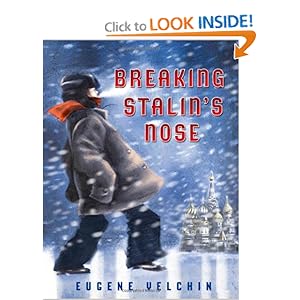
Breaking Stalin's Nose

Interesting title, isn't it? Breaking Stalin's Nose by Eugene Yelchin is a children's book, written from a young boy's perspective during the time of Stalin's rule of the USSR.

Sasha Zaichik is about to join the Young Pioneers - and he cannot wait! He writes a letter to Stalin as he waits for his father to come home from work. His father works in State Security, and Sasha is proud of the work he does, rooting out traitors from their country.

Suddenly, his world changes completely. The Secret Service comes and arrests his father. Sasha is shocked, and he immediately tries to go see Stalin, the great leader.  Sasha is sure Stalin would realize a big mistake has been made, and would immediately release his father.

However, things do not go as planned, and events go from bad to worse when Sasha makes his way to school the next day.

Yelchin does a masterful job of slowly exposing Sasha's naivete' throughout the course of the book - and exposing the sinister underpinnings of the system Sasha trusted explicitly. Yelchin grew up in the USSR, and used his own experiences to write this book - which he explains in an afterword.

Because of the disturbing nature of peer pressure, group-think, and manipulation, children should not read this book without an adult. (Which is why I'm reviewing it here instead of on my kid's book review blog.) However, with an adult's guidance and discussion, this book can be a powerful tool in helping children (and adults) understand how people survive in hostile dictatorships.

Tuesday, June 14, 2011

The Penderwicks at Point Mouette


If you've asked me for a good family book recommendation recently, you've probably heard me rave about The Penderwicks by Jeanne Birdsall. My children and I loved the first two books (The Penderwicks and The Penderwicks on Gardam Street) and anxiously awaited the release of the third.

I'm happy to tell you The Penderwicks at Point Mouette is available now - and it does not disappoint!

In the most recent book, the Penderwicks are split up. Dad and Iantha (with Ben in tow) are in England for a honeymoon. Rosalind is heading to New Jersey for two weeks with a friend. That leaves Skye, Jane and Batty in Aunt Claire's care for two weeks - and they're headed for Maine. The great hope is that Jeffery will join them for the two weeks... but his mother is their nemesis and may not let him go.

With Rosalind in New Jersey, Skye is now the OAP, Oldest Available Penderwick. Skye is not used to being in charge, and the responsibility of caring for her younger sisters - especially Batty - is stressing her out. Then she loses her all-important list of things to remember. How will she ever enjoy this vacation?

The Penderwicks at Pointe Mouette is just as delightful as the first two books - full of everyday adventures and roller coaster relationships. And one huge, amazing revelation. Do not read this book unless you have read the first two.

And if you haven't read the first two, what on earth are you waiting for??

Tuesday, January 26, 2010

Percy Jackson & The Olympians

My nephew is obsessed with the “Percy Jackson & the Olympians” series. He has read them all, and has sparked my son’s interest in reading these books. I like to know what my kids are reading, so when The Lightning Thief by Rick Riordan came in at the library, I grabbed it to read it first. (Mean, I know, but Nathaniel had schoolwork to do!)


I found it a little difficult to get into the book. There were so many unexplained events, so many questions that I thought took a long time to get answered. But, like the Alex Rider series, these books are action-packed.


Unlike Alex Rider, Percy Jackson is fantasy, in case you didn’t figure that out from the title of the series. The series is based on the idea that the Greek gods were real, are still alive and working today, and still running around messing around with humans and having children who are demigods, or half-bloods, or heroes (used interchangeably in the book).


Percy has to figure out how to live in the ‘real’ world while fighting monsters from the mythical world. He has some good friends, mentors and a magical pen, which turns into a sword he can use to fight the monsters. In The Lightning Thief, Percy is required to go on a quest, fighting all sorts of monsters, gods, and traps along the way.

Nathaniel told me this morning, “That book is really scary.” And it is, so I would not recommend it for grade-school children – especially those who are afraid that monsters live in their closets or under their bed.


But for boys old enough to handle the action, The Lightning Thief will capture, and hold, their attention and imagination. Nathaniel can't wait to read the rest of the series... especially since he's already done with the Alex Rider books.

Thursday, January 07, 2010

The House of Sixty Fathers


Meindert Dejong is probably one of the best children's literature authors you may have never heard of. I had never heard of him before I started using Sonlight's homeschooling curriculum.

Over the past few years, we have read Wheel on the School, Shadrach, and Along Came a Dog in school, so when I saw this year included a Meindert Dejong book, I was excited.

The House of Sixty Fathers is an excellent book. It's set in China during World War II and the Japanese Invasion of China. The back of my copy says it's for children ages 10-14, and I would agree with that.

The main character, Tien Po, is separated from his parents during the war. This book is about his journey to find them and the unexpected help he gives and receives along the way. It is set during a war, so Tien Po witnesses some awful things younger children may not be ready to process.

We finished reading The House of Sixty Fathers this morning. Actually, Anna finished reading it because I couldn't. They thought I couldn't read because I was laughing too hard. Au contraire! I was crying too hard! But I won't tell you why and ruin the ending.

Throughout the entire book, we were trying to figure out why it was called The House of Sixty Fathers. We ventured many guesses, but didn't discover the answer until nearly the last chapter - and then it all made sense.

This is a great book to read aloud to your children if they are 10 or older, unless your child is especially sensitive to emotional distress of separation and fear. My older children and I really enjoyed it.

Monday, November 16, 2009

Sadako and the Thousand Paper Cranes

This year, my older two children and I are studying the Eastern Hemisphere in school. I was very excited to finally start this year's curriculum - I'd been looking forward to studying the Eastern Hemisphere since I first decided on using Sonight curriculum in our homeschool six years ago.

We've already studied Australia, Antarctica, New Zealand, the Pacific Islands, and Japan - now we're working on China. The books that Nathaniel and Anna read on their own for Language Arts incorporate the same countries we're studying in History.

I used to read all the books, but with four students at home now I don't have time to read every single one. The older two know this, and so Anna made a special point to bring me Sadako and the Thousand Cranes when she had finished reading it a couple of weeks ago and told me to read it.

"It's really good, Mom," she said. "You need to read it."

I found it last week when I was cleaning off the kitchen counter, and thought I'd take some time to sit down and read it. It's a thin book, written for upper elementary students, so it's a quick and easy read. I think it took me about an hour at most.

And Anna was right. It is a very good book. She asked me today if I had read it and I said that I had.

"Did you like it?"

"Oh yes, I did. In fact, it made me a little teary."

Anna nodded sagely. I think she felt the same way after she finished it.

Sadako is based on the true story of a little girl in Japan who was a baby in Nagasaki when the atomic bomb exploded. Her family thought they had escaped the dreaded 'bomb sickness', until Sadako was sent home after a bad dizzy spell at school. Her best friend tells her that the gods will grant her wish to get well if she makes 1,000 paper cranes, so she decides to do it.

It is very thoughtfully and gently written, so I believe most older elementary students will enjoy reading or listening to it. However, if your child is especially sensitive, I'd suggest reading it first so you can decide if s/he is old enough to handle it.

Wednesday, October 07, 2009

Emma-Jean Lazarus Fell Out of a Tree


For the past two years, Anna has been longing, longing, longing to be a part of the Mother-Daughter book club at the library. It is for girls in 4th through 6th grade. She's been waiting and waiting and now, tonight, will be her first opportunity to participate.

She is beyond excited.

And I, her mother, almost forgot to sign us up.

That would have been very bad. Fortunately, I did remember, so the library gave us a copy of the book we're discussing this month - Emma-Jean Lazarus Fell Out of a Tree, by Lauren Tarshis.

I'm always a little leery of book club books. I don't know why. I guess I'm a little nervous because I'm not familiar with the title, the author, or the plot.

Anna read it first and was so excited when a character in the book called Emma-Jean "Nancy freakin' Drew" because she knew that literary reference. When she was done, she told me I would really like the book.

I picked up the book yesterday afternoon, since I almost forgot that I had to read it too, in order to participate in the Mother-Daughter book club.

I discovered it is absolutely delightful! (I was tempted to use italics in that sentence too, but decided I've really already overused them.)

Tarshis does a wonderful job in this book. At first I thought it was going to be all from Emma-Jean's perspective, but there are a few chapters from Connie's perspective (a 7th-grade classmate of Emma-Jean's). The change in voice is complete, and the drama makes me giggle. Emma-Jean's helpful solutions to her classmates' problems are... well, logical if not a tad bit unethical (which she realizes toward the end of the book).

I think my absolute favorite part is the letter Emma-Jean writes to the mother of the man who rents their 3rd-floor apartment. I laughed out loud when I read it.

All in all, Emma-Jean Lazarus Fell Out of a Tree is a great book for any 4th grader on up to read. Probably girls would like it a bit more than boys, since the main characters are girls. But boys could appreciate the logic with which Emma-Jean approaches life and relationships.

I also think this book gave me a little insight as to how to interact with my younger daughter, who is probably a bit like Connie. Bonus!

Wednesday, August 12, 2009

Princess Academy

My seven-year-old daughter brought me the audio book of Princess Academy this week when we were in the library. I'd never heard of it, but she told me her friend had told her that it was a really good book. Her friend is in junior high, so I thought I'd better read the book before listening to it with all the kids.

Princess Academy is a much quicker read than Inkheart, but that does not mean it is not good. In fact, I like Princess Academy much better than Inkheart.

The basic story line is that the girls from a mountain village are forced to go to an academy for an entire year to learn to be a princess because the priests in the capital said that the prince's wife will come from this village.

The girls do not read or write, most work in the mines. The story revolves around Miri, a young girl who's mother died when she was young. Miri's father does not allow her to work in the mines, which makes her feel useless. The academy comes, and she is forced to go.

Along the way, Miri learns the importance of education and reading, she learns how much she loves her village and really doesn't want to leave to be a wealthy princess. She learns to apply the lessons she's learned in the academy (the scene where she applies the Principles of Diplomacy is wonderful!), and learns a secret form of communicating she thought was only available to quarry workers.

Princess Academy is a wonderful, engaging story with great lessons for young girls - and boys (if you can get them to listen in or read it. There is plenty of adventure to keep them interested). I would recommend it for older elementary or junior high students. Miri talks about her feelings for her childhood friend and her conflict over wanting to be with him or be the princess with the beautiful dresses and houses. Good things to think about for older girls - I think my girls are a bit too young to be thinking about those topics.

In a few more years, we'll listen to this audio book as a family. I know we'll all enjoy it.

Tuesday, August 11, 2009

Inkheart

My kids have seen the advertisements for the movie Inkheart and have begged to watch it. The rule in our house is that I need to see a movie before they can watch it (well, as much as possible). I didn't feel like watching a movie, and noticed the book at our library, so I picked it up since the books are usually better than the movie.

Inkheart is a very long book. I enjoyed reading it very much, but I don't think my kids are ready to listen to the book or watch the movie. I was immediately pulled in to the story of the book, wondering what the mystery was, what the secret was, why Meg and her father Mo were hiding.

And I was scared. Inkheart is a very scary book. Perhaps it is scarier than the movie - I've not seen it - because of the images I create in my imagination. My children scare easily, and I do not plan on reading this book to them. I think my 11-year-old son would enjoy reading this book on his own, but not for several years.

One thing I really enjoyed about Inkheart are the little excerpts at the beginning of each chapter. They're taken from many different children's books, some of which I wasn't familiar. They set the emotional tone for the chapter and in some cases, revealed the inspiration of the events of the chapter.

The premise is that Mo can read characters and things out of books he reads aloud. He didn't realize he had this gift until one night he read an evil character out of a book, and his wife (Meg's mother) went into the book. This causes all sorts of problems, and in the course of the story, Meg realizes she has the same gift. The ending feels a long time coming, but is very creative.

Overall, Inkheart is a good, but scary book. I'd recommend it for an older reader who can handle scary books.